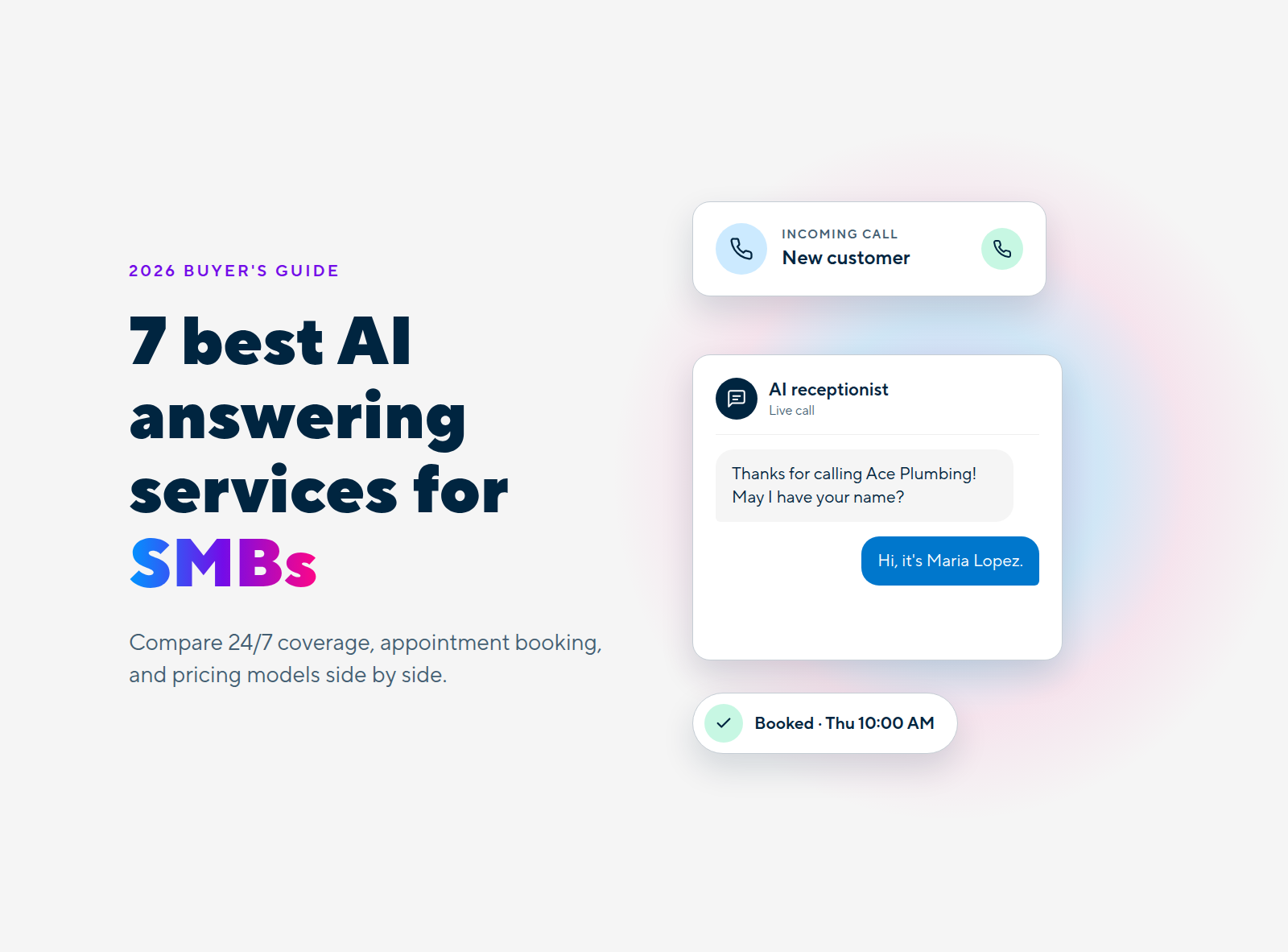
What is an AI Receptionist?
An AI receptionist is an automated voice system that answers incoming calls, understands callers' needs, provides information, and routes them to the right person or department. Unlike a traditional auto-attendant, an AI receptionist can understand natural-language requests and respond conversationally.
Businesses use AI receptionists to handle routine calls, provide after-hours coverage, manage call overflow, collect information, and reduce employee time spent on repetitive call handling.
But the capabilities and pricing of AI receptionists vary widely. Some are designed for basic call answering, while others can integrate with your phone system and business applications to handle more complex workflows.
This guide explains how AI receptionists work, how they compare with live virtual receptionists, what features to look for, how pricing works, and how to choose one for your business.
How Does an AI Receptionist Work?
An AI receptionist uses artificial intelligence (AI) to understand a caller's request and determine what should happen next. Instead of requiring callers to navigate a fixed menu, it can interpret what they say and respond based on configured workflows.
A typical interaction looks like this:
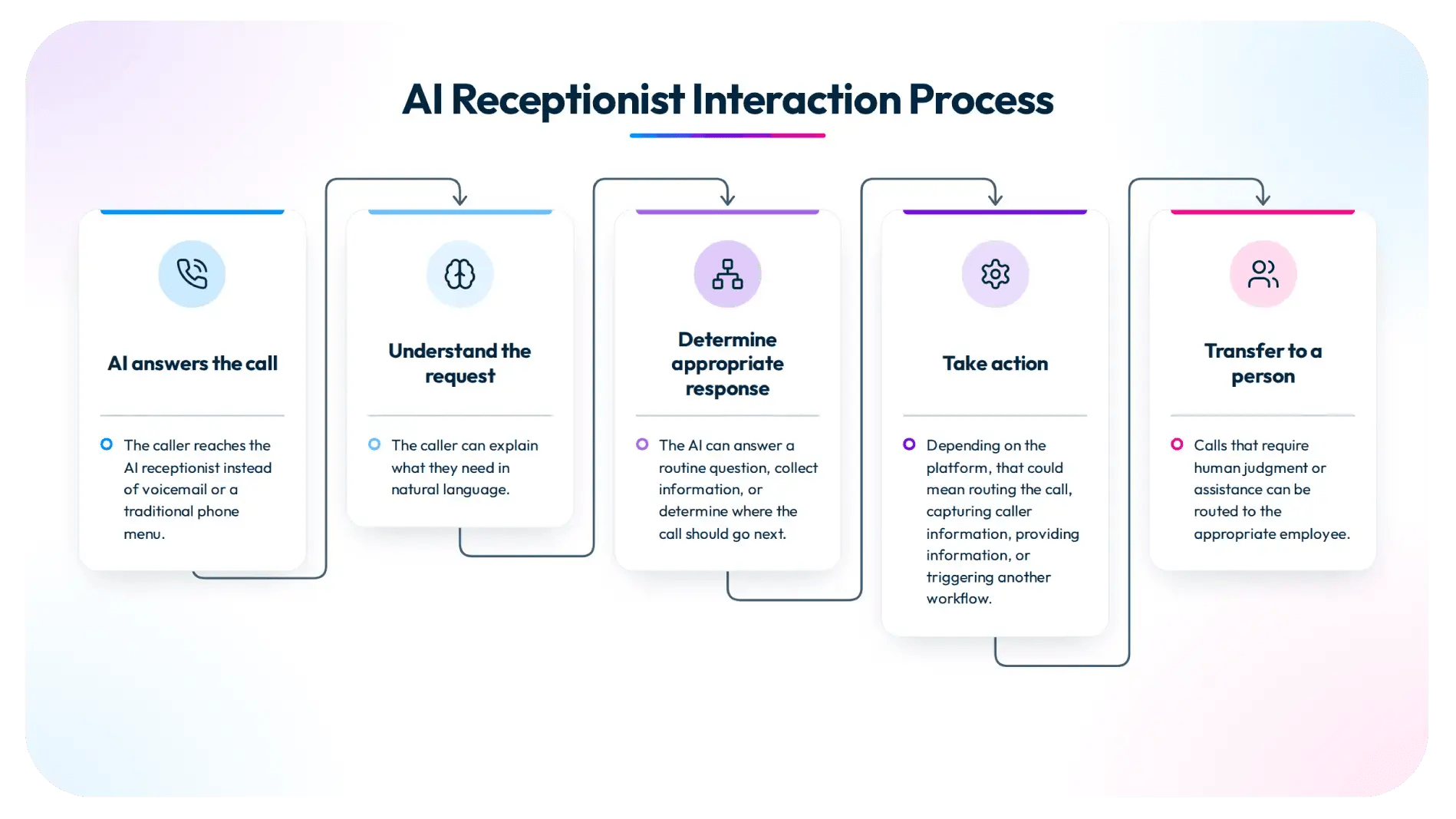
- The AI answers the call: The caller reaches the AI receptionist instead of voicemail or a traditional phone menu.
- It understands the request: The caller can explain what they need in natural language. For example, a caller doesn't necessarily have to say, “Press 2 for billing.” They might simply say, “I have a question about my invoice,” and the AI can use that request to figure out the next steps.
- It determines the appropriate response. The AI can answer a routine question, collect information, or determine where the call should go next.
- It takes action. Depending on the platform, that could mean routing the call, capturing caller information, providing information, or triggering another workflow.
- It transfers to a person when needed. Calls that require human judgment or assistance can be routed to the appropriate employee.
AI receptionist vs. traditional auto-attendant
A traditional auto-attendant typically relies on predefined menu options, “Press 1 for sales. Press 2 for support. Press 3 for billing.”
An AI receptionist can interpret natural-language requests and respond conversationally.
That doesn't make an AI receptionist a replacement for every phone-system feature. In many cases, the most useful approach is to have AI work alongside existing call routing, queues, extensions, and other communications capabilities.
Why Use an AI Receptionist?
An AI receptionist can handle calls that don't require an employee, so your team can spend less time on repetitive tasks like answering frequently asked questions, transferring calls, and taking basic messages.
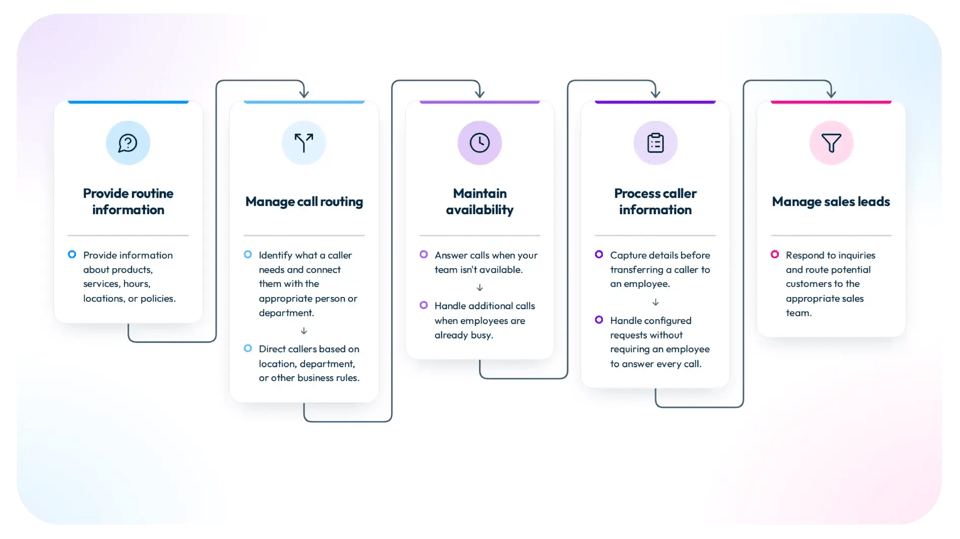
Common use cases include:
- Routine questions: Provide information about products, services, hours, locations, or policies.
- Call routing: Identify what a caller needs and connect them with the appropriate person or department.
- After-hours coverage: Answer calls when your team isn't available.
- Call overflow: Handle additional calls when employees are already busy.
- Information collection: Capture details before transferring a caller to an employee.
- Appointment or service requests: Handle configured requests without requiring an employee to answer every call.
- Lead handling: Respond to inquiries and route potential customers to the appropriate sales team.
- Multi-location call handling: Direct callers based on location, department, or other business rules.
AI Receptionist vs. Live Virtual Receptionist Service: What's the Difference?
An AI receptionist and a live virtual receptionist both help businesses handle calls when an in-house employee isn't available, but they use very different approaches.
A live virtual receptionist is a real person, typically provided by an outsourced service, who answers calls on your business's behalf. They can greet callers, take messages, route calls, schedule appointments, and handle other tasks based on your instructions.
An AI receptionist uses conversational AI to handle calls automatically. It can answer questions, identify what a caller needs, route calls, capture information, schedule appointments, and transfer callers to a person when necessary.
The right option depends on the types of conversations your business handles and how much human involvement they require.
| |
AI Receptionist
|
Live Virtual Receptionist
|
|
Who Answers?
|
AI
|
A remote human receptionist
|
|
Availability
|
Typically 24/7
|
Depends on the service and plan
|
|
Routine Call Handling
|
Automated
|
Handled by a receptionist
|
|
Call Routing
|
Can identify intent and route calls
|
Can route calls based on instructions
|
|
Complex or Sensitive Conversations
|
Can escalate to a person
|
Handled by a person
|
|
Appointment Scheduling
|
Can automate scheduling when integrated with the right systems
|
Can schedule appointments on your behalf
|
|
Scalability
|
Can handle multiple calls simultaneously
|
Scales by adding receptionists or upgrading your plan.
|
|
Best Suited For
|
High-volume or repetitive call workflows that can be automated
|
Businesses that want a human touch for incoming calls
|
As Daniel Leubitz, Head of Product at net2phone, explains in his recent LinkedIn post, the opportunity with AI isn't simply finding another way to answer the phone. It's about determining what should happen during the conversation and automating the steps that don't require a person.
That distinction can help when deciding between the two. If callers frequently need judgment, reassurance, or nuanced human interaction, a live receptionist may be better suited to those conversations. If many calls involve predictable questions, routing, information capture, or other repeatable tasks, an AI receptionist may be able to handle more of that work automatically.
What Should You Look for in an AI Receptionist?
The best AI receptionist for your business should fit your call workflows, existing communications environment, and operational requirements.
Look for these capabilities:
1. Natural-language conversations
The caller should be able to explain what they need in their own words, and the AI should accurately identify the caller's intent.
Test the system by using different ways to ask the same question. A useful AI receptionist should be able to handle normal variations in language rather than relying on one exact phrase.
2. Call routing and transfers
Answering a call is only the first step. The AI should be able to identify where the caller needs to go and route the conversation appropriately based on your business rules.
Ask:
- Can it route by department?
- Can it route by location?
- Can it account for business hours?
- Can it transfer to specific employees?
- What happens when nobody is available?
3. 24/7 and after-hours coverage
An AI receptionist can answer calls outside normal business hours, during holidays, or when your team is already handling other calls.
For businesses serving customers across multiple time zones, this can extend coverage without requiring additional shifts.
4. CRM and business-system integrations
An AI receptionist shouldn't have to operate in isolation.
Depending on the platform, integrations can allow the AI to work with information stored in your CRM or other business systems.
But don't stop at the word “integration.”
Ask what the integration actually allows the AI to do.
Can it retrieve information? Capture information? Update records? Trigger workflows? Pass context to the employee receiving the call?
Those details matter more than a list of logos on a vendor's integrations page.
5. Call records, summaries, and analytics
The conversation shouldn't disappear when the caller hangs up.
Look for capabilities such as call recordings, transcripts, summaries, and analytics that help your team understand call volume and customer needs.
This can also give IT and operations teams a way to measure whether automation is actually reducing workload.
6. Human handoff
AI shouldn't be expected to handle every conversation.
Ask what happens when the caller needs a person.
A good handoff should get the caller to the right employee without creating unnecessary repetition. Find out what information is passed along and whether the employee can see what happened earlier in the conversation.
7. Reliability and security
Voice communication is a business-critical infrastructure.
Ask vendors about uptime, security controls, encryption, authentication, compliance requirements, and how the AI capability fits into the reliability of your broader communications platform.
8. Scalability
The solution should work as your business grows.
That could mean more calls, more employees, more locations, or more complex workflows.
For multi-location businesses in particular, ask how easily administrators can manage call-handling rules across locations without creating a separate process for every site.
How Much Does an AI Receptionist Cost?
AI receptionist pricing varies by provider and can depend on call volume, usage, features, integrations, and coverage requirements.
Common pricing factors include:
- Number of calls or minutes
- Number of locations or phone numbers
- AI capabilities
- Integrations
- Call recording and analytics
- After-hours coverage
- Human handoff requirements
- Implementation and support
- Whether the AI receptionist is part of a broader communications platform
Some providers charge based primarily on usage. Others bundle AI capabilities into a larger business communications package.
That's why the advertised monthly price doesn't tell you the full cost.
What is the total cost of an AI receptionist?
To compare options, consider the cost of the work you're replacing or reducing.
For example, an AI receptionist might reduce the amount of employee time spent:
- Answering repetitive calls
- Transferring callers
- Taking basic messages
- Providing routine information
- Handling after-hours inquiries
It can also reduce the need for separate answering services or additional coverage during high-volume periods.
So the relevant calculation isn't simply:
AI receptionist price = total cost
It's:
AI receptionist cost + existing communications costs − the operational work and costs it replaces or reduces
Calculate your potential AI receptionist savings
Calculate your savings considering:
- Monthly inbound calls
- Average minutes per call
- Average employee cost per hour
- Percentage of calls suitable for automation
For current net2phone plan information, see Business Communications Plans & Pricing.
How to Choose the Best AI Receptionist for Your Business
Start with your calls, not the technology.
The right AI receptionist should solve a defined operational problem and work with the systems you already use.
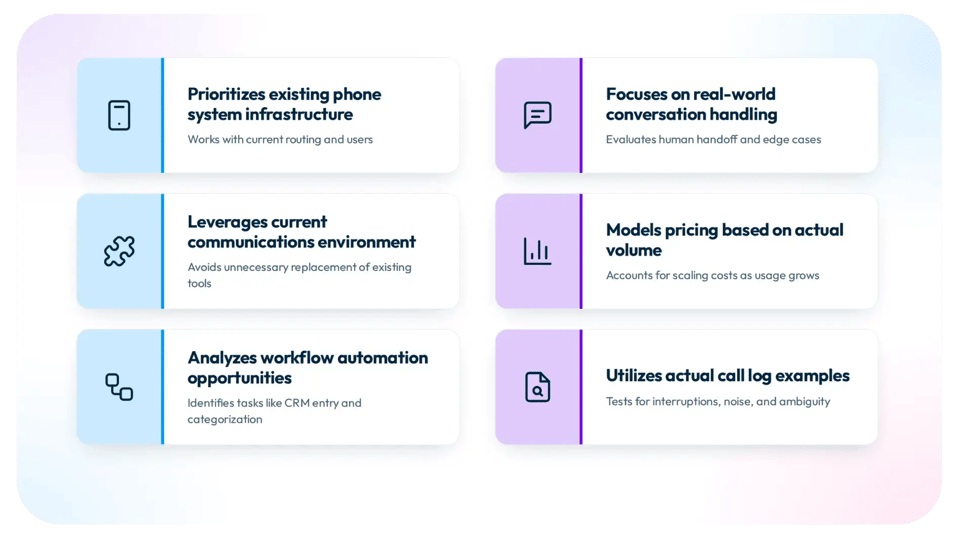
1. Identify your most common call types
Review your call data and group calls into categories such as:
- General questions
- Sales inquiries
- Billing questions
- Support requests
- Appointment or service requests
- Call transfers
- Status requests
- After-hours calls
Then identify which categories require a person and which follow predictable patterns.
2. Find the work around the conversation
Don't just ask what callers want.
Ask what your employees have to do because of the call.
Do they manually enter information into a CRM? Send follow-up emails? Categorize calls? Take notes? Transfer callers between departments?
These steps can reveal automation opportunities that aren't obvious from the call itself.
This is especially important when evaluating AI as part of a broader communications strategy, including contact center automation.
3. Check compatibility with your existing phone system
If you already have a business phone system, replacing it may not be necessary.
Look for an AI receptionist that can work with your existing communications environment.
Ask whether it supports your current routing, numbers, users, call queues, and other requirements.
4. Test the human handoff
Ask the vendor to demonstrate a call that the AI can't handle.
Then look at what happens.
Does the caller reach the right person? Does that employee receive context? Does the caller have to repeat their request?
A human handoff is part of the customer experience, not an exception to it.
5. Test real conversations
Don't evaluate the platform only through a polished demo.
Bring examples from your own call logs.
Try different wording, interruptions, ambiguous requests, background noise, and requests that require a transfer.
You'll get a much better sense of whether the technology fits your business.
6. Compare the total cost at your actual call volume
Ask each vendor to model pricing using your numbers.
A platform that looks inexpensive at low usage can have a different cost structure as call volume grows.
Also consider whether you're paying separately for your phone system, AI, analytics, integrations, and other capabilities.
The Business Impact: What Are the Business Benefits of an AI Receptionist?
The business impact of an AI receptionist comes down to three things: how many calls it can handle, how much work it removes from employees, and how it affects the customer experience.
Fewer missed calls
An AI receptionist can answer calls when employees are unavailable, reducing the number of callers who reach voicemail or receive no response.
Faster response
Callers get answers or reach the right person without waiting. Getting it right the first time pays off: SQM Group, a contact center benchmarking company, found every 1% improvement in first-call resolution (FCR) brings a 1% improvement in customer satisfaction.
Lower operational costs
Automating routine conversations can reduce the time employees spend on call handling and provide coverage without adding equivalent staffing capacity. SQM Group also found that each 1% improvement in FCR reduces operating costs by 1%
More consistent call handling
Configured workflows can give callers a consistent experience across departments, locations, and operating hours.
Better visibility into call activity
Call records, transcripts, summaries, and analytics can help teams understand what customers are asking and where call-handling processes can improve.
AI Receptionist FAQs
What is an AI receptionist?
An AI receptionist is an automated voice system that answers incoming calls, understands what callers need, responds to questions, and routes or handles calls based on configured workflows. Unlike a traditional auto-attendant, it can understand natural-language requests and respond conversationally.
How does an AI receptionist actually answer and route calls?
An AI receptionist answers the incoming call, interprets the caller's request, and determines the appropriate response or destination based on its configured workflows. It may answer the question directly, collect information, or transfer the caller to a person or department.
Is an AI receptionist better than a live virtual receptionist service?
It depends on the type of calls your business receives. AI receptionists can handle repetitive interactions at scale and provide 24/7 coverage, while live receptionists can be better suited to conversations that require human judgment or personalized assistance. Some businesses may use both.
How much does an AI receptionist cost?
AI receptionist pricing varies by provider, call volume, usage, features, integrations, and coverage requirements. Compare total cost rather than looking only at the advertised monthly AI fee.
Can an AI receptionist integrate with my CRM and existing phone system?
Some AI receptionists can integrate with CRMs and existing phone systems. Capabilities vary by provider, so ask what the integration actually allows the AI to do, such as retrieving information, capturing details, updating records, or triggering workflows.
Can an AI receptionist handle calls 24/7, including after-hours and overflow?
Yes. AI receptionists can provide automated coverage outside normal business hours and during periods of high call volume. The exact capabilities depend on the provider and how the call workflows are configured.
How accurate and reliable is an AI receptionist at understanding callers?
Accuracy depends on the technology, configuration, call quality, background noise, and complexity of the request. Test the system using real examples from your business rather than relying only on a scripted demonstration.
What should a growing or multi-location business look for in the best AI receptionist?
Look for reliable call handling, flexible routing, integrations, analytics, scalability, security, and a clear human handoff process. Multi-location businesses should also consider how easily administrators can manage workflows across locations.
Does an AI receptionist replace my phone system, or work with what I already have?
It depends on the platform. Some AI receptionists operate as standalone services, while others integrate with existing business phone systems. If you already have a communications platform, integration can help AI call handling work within your existing calling and routing environment.
How net2phone AI Agent Works With Your Phone System
net2phone AI Agent brings AI-powered call handling into the broader business communications environment.
Rather than treating an AI receptionist as a separate answering service, AI Agent can work with communications capabilities to handle incoming conversations, answer questions, collect information, and route callers when a human is needed.
This makes AI part of the phone workflow rather than another disconnected application.
For businesses already using net2phone’s business phone system or contact center platform, AI Agent works with the platform's communications capabilities, giving teams a way to add AI-powered call handling without treating it as an entirely separate system.
What does that look like in practice?
Imagine a customer calls outside business hours with a routine question.
Instead of reaching voicemail, the AI Agent can answer the call, understand the request, provide the appropriate information, and handle the next step based on the configured workflow.
During business hours, it can also help manage overflow when employees are already handling other calls.
The same principle applies across different locations or departments: automate the conversations that follow predictable workflows while giving employees the context and opportunity to step in when human involvement is needed.
net2phone’s AI Agent resolves approximately 70% of conversations automatically and provides up to 8x cost reduction compared with human agents.
Because AI Agent runs on net2phone's communications platform, backed by 99.98% uptime, AI call handling doesn't add a new point of failure to your phone system.
Want to see what AI could handle for your business? Talk to our team about your call workflows and see how net2phone AI Agent could fit into your phone system.
→ Book a demo to see AI Agent in action.



 AI Agent Every conversation handled, automatically.
 Coach AI Automated coaching for high performance.
 AI Answering Service Ensure every call gets answered.
 Unite AI-driven phone system for business
 Call Center Essentials Core tools to help agents excel.
 uContact Customer-first contact center platform.
 Integrate Build automated workflows visually without coding.
 Global Connect Unify your global business communications.
 Developer Portal Connect your app to net2phone.