A chatbot follows a script; conversational AI understands what customers mean; and an AI agent understands the request and takes action to resolve it.
They can all help businesses automate customer service. But they aren't the same thing.
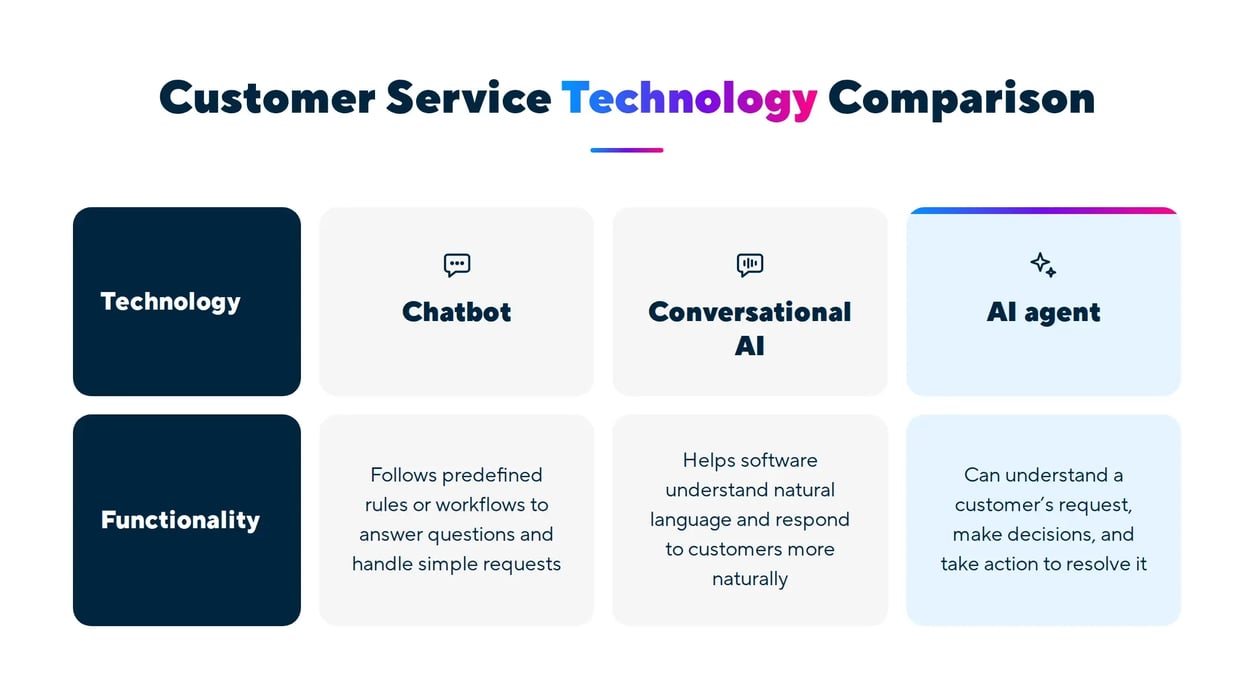
- A chatbot follows predefined rules or workflows to answer questions and handle simple requests.
- Conversational AI helps software understand natural language and respond to customers more naturally.
- An AI agent can understand a customer's request, make decisions, and take action to resolve it.
For contact centers, the difference decides whether a tool simply answers questions or actually reduces wait times, transfers, and workload.
Here's what to know about each one and how to choose the right approach for your contact center.
What Is a Chatbot?
A chatbot is software that communicates with customers through text or voice. Traditional chatbots follow predefined rules, scripts, or workflows to answer questions and guide customers through simple tasks.
Think of a traditional chatbot as a well-organized FAQ that can talk back. When a customer asks a question it was built for, it answers instantly. When they don't, it has nowhere to go.
How Does a Chatbot Work?
A traditional chatbot matches what a customer types or says to a set of predefined responses. Someone has mapped every path in advance.
For example, a customer writes: "I think I got charged twice this month."
A rule-based chatbot spots the word "charged" and replies with a menu: Billing, Technical Support, or Something Else. The customer picks Billing and gets a link to the billing FAQ. If that doesn't solve it, the chatbot hands them to a human agent, often with no record of what was already said.
Some chatbots use conversational AI to understand natural language, so not all chatbots work the same way.
Pros and Cons of Chatbots
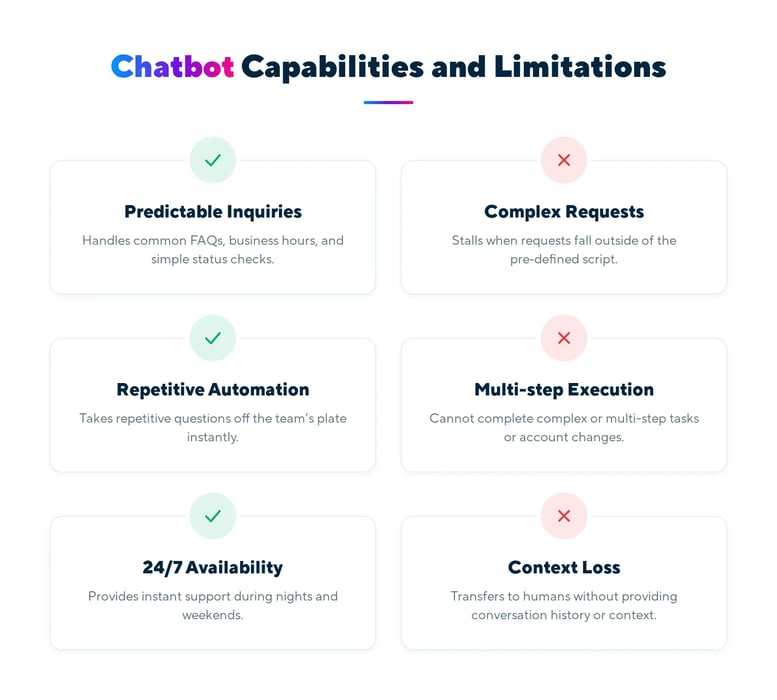
A customer service chatbot works best when customers ask predictable questions with fixed answers. It can share business hours and policies, answer common FAQs, check simple order or ticket status, and collect basic contact details, all instantly and 24/7.
A chatbot’s limitations show when a request doesn’t fit the script. A rule-based chatbot can’t complete multi-step tasks or make changes to an account. When it hands the customer to a human, the conversation history usually doesn’t come with it.
Pros
- Answer common questions instantly, with no wait
- Stay available 24/7, including nights and weekends
- Take repetitive questions off your team's plate
Cons
- Stall when a request doesn't fit the script
- Can't complete complex or multi-step tasks
- Often hand customers to a human without the context of the conversation
What Is Conversational AI?
Conversational AI is technology that allows software to understand and respond to human language naturally. It uses natural language processing (NLP), machine learning, and, increasingly, large language models to interpret what customers mean, not just the words they use.
Think of conversational AI as a good listener.
How Does Conversational AI Work?
Conversational AI analyzes a customer's message or speech to identify their intent, then generates a relevant response. It recognizes the many ways people phrase the same request, remembers what was said earlier in the conversation, and asks clarifying questions when something is unclear.
For example, a customer writes: "I think I got charged twice this month."
Conversational AI recognizes a possible duplicate charge, explains the refund policy, and asks on which date the extra charge appeared. The conversation feels natural.
Then it reaches its limit: "Thanks. I've passed this to our billing team, and they'll follow up within two business days."
The customer was understood, but the problem still isn't solved.
Pros and Cons of Conversational AI
Pros
- Understands natural language, typos, and varied phrasing
- Keeps context, so customers don't repeat themselves mid-conversation
- Makes self-service feel like a conversation instead of a menu
Cons
- Answers questions but usually can't complete tasks
- Only as accurate as its training data and your knowledge base
Chatbot vs. Conversational AI: What's the Difference?
A chatbot is an application. Conversational AI is the technology that helps it understand people. Traditional chatbots follow scripts, while chatbots built with conversational AI can understand intent, varied phrasing, and context.
That’s why conversational AI for customer service makes self-service feel like a real conversation instead of a menu. But in both cases, the focus is on understanding and responding, not on resolving the request. That’s where AI agents come in.
What Is an AI Agent?
An AI agent is software that understands customer requests and takes action to resolve them. It starts with everything conversational AI does, then adds the ability to reason through multi-step tasks and work inside your connected business systems. This is what’s often called agentic AI for customer service.
How Does an AI Agent Work?
An AI agent identifies what the customer needs, determines the steps required, and completes them using connected tools. For example, it can update a record in Salesforce, create a ticket in Zoho Desk or Jira, book an appointment in Google Calendar, or process a payment through Square, all through connected business systems.
Here's how that looks in practice. A customer writes: "I think I got charged twice this month." The AI agent:
- Verifies the customer's identity
- Pulls up their billing history and confirms the duplicate charge
- Issues the refund through the connected payment system
- Logs the interaction in the CRM
- Confirms: "You're all set. The duplicate charge has been refunded."
The problem is solved in one conversation, with no ticket, no follow-up, and no waiting.
When a request needs human judgment, the AI agent can transfer the conversation to a live agent with full context, so the customer never has to start over.
Pros and Cons of AI Agents
Pros
- Resolve routine requests end-to-end, in one conversation
- Take action in CRMs, help desks, calendars, and payment systems
- Can work across voice, chat, and web
- Cut transfers, follow-ups, and wait times
Cons
- Need integrations with your business systems to deliver full value
- Usually costs more upfront than a basic chatbot, including licensing, integration setup, and time to configure workflows and guardrails
- Need clear guardrails and escalation rules for sensitive or complex requests
AI Agent vs. Chatbot vs. Conversational AI: Side-by-Side Comparison
The easiest way to compare the three is to look at what each one can understand and do.
| |
Chatbot
|
Conversational AI
|
AI Agent
|
|
Primary purpose
|
Answer questions and guide customers through predefined workflows
|
Understand and respond to natural language
|
Understand requests and complete tasks
|
|
Understands natural language
|
Sometimes
|
Yes
|
Yes
|
|
Uses conversation context
|
Limited
|
Yes
|
Yes
|
|
Takes actions in business systems
|
Limited
|
Depends on implementation
|
Yes
|
|
Autonomy
|
Follows predefined paths
|
Responds flexibly but doesn’t act on its own
|
Decides on and completes steps within set guardrails
|
|
Handles multi-step tasks
|
Usually limited
|
Limited
|
Yes
|
|
System integrations
|
Read-only knowledge base
|
Limited lookups
|
Reads and writes across CRM, help desk, payments, and ERP
|
|
Supports human handoff
|
Yes
|
Yes
|
Yes, with context
|
|
Channels
|
Mostly web chat; some voice
|
Chat and voice
|
Voice, chat and web
|
|
Best for
|
FAQs and predictable requests
|
Natural, flexible conversations
|
End-to-end customer service automation
|
The lines aren't always absolute. A chatbot can use conversational AI. A conversational AI system can have integrations and perform certain actions.
The important question when comparing vendors is what the system can actually do, not what the vendor calls it.
Beyond Chat: Why AI Voice Agents Matter for Contact Centers
Most AI agent vs. chatbot comparisons focus on website chat. But for contact centers, the phone is still one of the busiest channels, and it’s where long hold times, multiple transfers, and abandoned calls tend to happen.
That makes AI voice agents an important part of the decision, especially for teams moving off a traditional PBX or building omnichannel routing across voice and digital channels.
An AI voice agent uses AI to understand spoken language and respond to customers over the phone.
For example, instead of forcing a caller through a series of menu options:
“Press 1 for sales. Press 2 for support. Press 3 for billing.”
An AI voice agent can let the caller explain what they need in their own words.
For example, the customer could say, “I was charged twice for my order and need help getting one of the charges reversed.”
The AI can understand the reason for the call and, depending on its integrations and permissions, look up the relevant information, take the appropriate action, or connect the caller with a human agent.
This is particularly useful for contact centers because the same types of routine requests that businesses automate via chat can also come in over the phone.
net2phone’s AI Agent works across phone, chat, and web, so businesses can use the same AI-powered assistance across every customer service channel.
Chatbot or AI Agent: Which Is Right for Your Contact Center?
The difference between an AI agent and a chatbot matters most when you look at the requests your customers actually make. A chatbot isn’t automatically the wrong choice. The right technology depends on what you need it to do.
When a chatbot is enough
A chatbot may be all you need if customers primarily ask simple, predictable questions.
For example:
- What are your business hours?
- What's your return policy?
- Where can I find your pricing?
- How do I reset my password?
- How can I contact support?
If the answers are straightforward and the customer doesn't need the system to make any changes, a chatbot can provide useful self-service.
When you need an AI agent
An AI agent becomes more useful when customer requests require information from multiple systems, decisions, or actions.
For example:
- A customer wants to make or change an appointment.
- A customer needs an account record updated.
- A customer wants to make a payment.
- A customer needs help with an existing support ticket.
- A customer has a question that requires information from their account.
- A customer needs to be transferred to another team with the conversation context preserved.
In these cases, simply answering the customer's question isn't enough.
The AI needs to do something.
An AI agent can still answer the simple questions a chatbot handles, like business hours, policies, and FAQs. So if you need both, a single system can handle routine questions and complex requests without sending customers to a different tool partway through the conversation.
What should you look for when evaluating an AI agent?
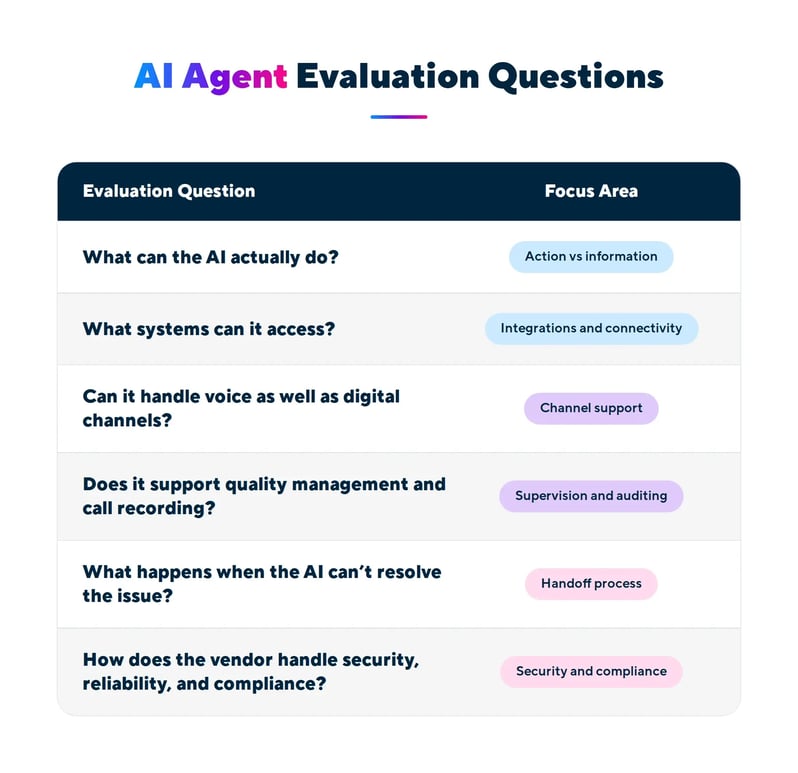
If you're comparing AI agent platforms, look beyond the label. Here are the questions to ask when evaluating an AI agent:
- What can the AI actually do?
Find out whether it can take action or only provide information.
- What systems can it access?
Check which CRM, help desk, payment, scheduling, and other integrations are available, and ask whether they’re native or require APIs, webhooks, or custom development.
net2phone’s AI Agent connects with major CRMs, help desks, email, collaboration, ERP, and calendar tools using a simple drag and drop workflow builder. Other systems can connect through APIs or webhooks. See the full list of integrations.
- Can it handle voice as well as digital channels?
If phone calls are an important part of your contact center, make sure the solution supports voice, not just website chat.
- Does it support quality management and call recording?
To trust AI with customer conversations, you need to be able to review them. Look for call recording, conversation transcripts, and quality management tools so supervisors can audit AI interactions the same way they review human agents.
- What happens when the AI can't resolve the issue?
Customers should be able to reach a human when necessary. Look for a handoff process that preserves relevant conversational context rather than making the customer repeat everything.
- How does the vendor handle security, reliability, and compliance?
An AI agent may have access to customer information and business systems, so these requirements should be part of your evaluation from the beginning.
What Can an AI Agent Do for Customer Service?
The value of an AI agent comes from how much work it can handle without a human agent stepping in. Instead of only answering questions, it can automate customer service processes from start to finish:
- Answering routine questions
- Looking up customer information
- Updating records and creating tickets
- Scheduling appointments and processing payments
- Routing conversations and escalating complex issues
- Working across voice and digital channels
For contact center leaders, that shows up in the metrics that matter most. First-contact resolution increases because routine requests are resolved in a single conversation. Response times drop because customers don’t wait in a queue for simple tasks. CSAT improves when customers don’t have to repeat themselves or wait for a follow-up.
net2phone’s AI Agent can resolve up to 70% of conversations automatically, with up to 8x cost reduction compared with human agents.
The goal isn’t to replace every interaction with AI. It’s to let AI handle what it can resolve well and free your agents for the conversations that need a human. It’s one part of a broader approach to customer service automation.
See how net2phone’s AI Agent resolves calls and chats end to end. Request a demo →
Frequently Asked Questions
What is the difference between an AI agent and a chatbot?
A chatbot primarily answers questions and guides customers through predefined workflows. An AI agent can understand a customer's request and take action in connected business systems to resolve it.
Is conversational AI the same as a chatbot?
No. Conversational AI is the technology that helps software understand and respond to natural language. A chatbot can use conversational AI, but conversational AI can also be used in other applications, including AI agents.
How do AI agents help in customer support?
AI agents resolve routine customer requests from start to finish. They can look up account information, schedule appointments, route conversations, and update records in connected systems. They escalate complex issues to human agents with full context, and they work 24/7.
What customer service tasks can a chatbot handle on its own?
A chatbot can handle predictable requests such as answering FAQs, providing business hours and policies, checking simple status information, and collecting customer information. More complex requests that require system changes or multiple steps may require an AI agent.
Can AI agents handle phone calls, not just chat?
Yes. AI voice agents understand spoken conversations, respond to callers, route calls, and help resolve customer requests. net2phone’s AI Agent works across phone, chat, and web.
Can AI agents integrate with CRMs and other business tools?
Yes. For instance, net2phone’s AI Agent can connect with Salesforce, HubSpot, and Zoho CRM; Zoho Desk and Jira; Gmail and Outlook; Slack and Microsoft Teams; Square; Odoo; and Calendly, Google Calendar, and Microsoft Calendar. See all integrations.
Is an AI agent more expensive than a chatbot?
An AI agent usually has a higher upfront cost than a basic chatbot because it supports more advanced capabilities and integrations. But the more useful comparison is cost per resolution. net2phone’s AI Agent can resolve up to 70% of conversations automatically and offers up to 8x cost reduction compared with human agents. View plans and pricing.



 AI Agent Every conversation handled, automatically.
 Coach AI Automated coaching for high performance.
 AI Answering Service Ensure every call gets answered.
 Unite AI-driven phone system for business
 Call Center Essentials Core tools to help agents excel.
 uContact Customer-first contact center platform.
 Integrate Build automated workflows visually without coding.
 Global Connect Unify your global business communications.
 Developer Portal Connect your app to net2phone.